Sunday, September 6, 2009

A Philosophy of Zeno

(Continuing from Philosophies on God)... For example, the great Greek philosopher Zeno of Elea (490?-430?) proposed this mathematical truth:
A runner could never [mathematically] cross a course and complete a race. This is due to the fact that a person must first cover half the distance to the purposed point of contact. After which, the person must then cover half of the remaining distance. At no point does the resulting mathematics truthfully reach zero allowing for the completion of the task.

Zeno of Elea studied under Parmenides (515?-450?). Parmenides was the most important early Greek philosopher to live before Socrates.
He taught that the origin and nature of reality must be taken from logical arguments. What is not is a notion not able to properly thought of or spoken of. Parmenides taught Zeno that the world, when not defined by what is not but what is, is just one thing -- unchanging, perfect without a beginning or end.
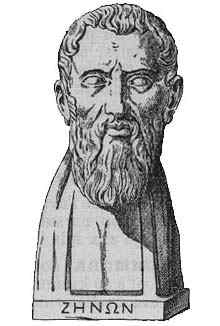
In the end, Zeno proposed several paradoxes using reductio ad absurdum, or deriving impossible conclusions from opponent opinions. However only four such paradoxes have survived. Because all things consist of motion, this was his main focus in arguments. What we may lose in exploring ancient philosophy is the level of understanding these men had, yet never where they as technologically inclined as we are today. Motion is the basis of almost all matter, and Zeno understood this. By his postulate, Zeno shows the conundrum of trying to understand the nature of life; there is more at work than simple mathematics.

Secondly, is the belief that The Creator, in being all powerful, is therefore perfect; and by being perfect allows for perfection in His’/Hers creations. In the book of John in the Gospels of Christianity, Jesus states, “...Be ye therefore perfect, as your Father in heaven is therefore perfect.” This statement not only alludes to spiritual perfection, but physical perfection. In the beginning, in Genesis, Adam is made in the image of God. Yet alone Adam would not be anything more than a body in timeless space. Before Adam the world was created, and it was perfect. What this example shows is that for a being to have a 'perfect' existence not only must the being be 'perfect' but the environment as well.

In meditative religions perfection is accomplished through prayer, fasting, and meditation ultimately leading to a state of nirvana, total enlightenment. This leads me to question, “how can a man, being erroneous in the sense that perfection is complete efficiency and total understanding, make himself perfect.” It obviously takes more than what the man contemplating the question contains. The human is a considered a system, energy and materials enter in, are processed, and then are arranged into an ordered structure. From there they are used, producing waste and the inefficient process of energy loss.

This is what is meant by evolution, nature’s best attempt at creating balance and stability. All things therefore evolve. Evolution of a species may take centuries, but technology, science, and understanding are ever evolving; this applies to knowledge as well. When an experience effects a being's thoughts, the being is thereby changed. Of course, this is not considered a physical change but a metaphysical one; one in which the thought process changes to incorporate the new information. The same process is seen in the case of physical evolution as Charles Darwin already explained. The primary focus of developmental evolution being that the change becomes a permanent in the biological structure of the organism. The change in the biological structure thereby affecting the offspring by hereditary transportation.

The third base belief is the purpose of life itself. In evaluating the belief structures of several religions, Wysong [see Philosophies on God Entry 08/20/09] presents that creationist are given structure in their lives based on the necessary need to rely on The Creator. The reason for this being that the creationist's life and development is under the direction of The Creator and therefore The Creator is responsible for the supplying of life. The creationist is likewise responsible for giving respect and joy to The Creator.

For every person, there is or are some driving factor(s) that make us want to be more than we were the day before. Granted of course, that there are those who could careless about growth and understanding, for the majority of human beings, life is geared toward experiencing more, knowing more, and understanding more. This is therefore the beginning of any civilization’s growth into controlling its evolutionary development. Without some central understanding of the matter that makes up existence, any civilization is bound for chaos. In the overall view of existence it does not matter where we came from, no one can retrace the steps, what matters now is what we do with the existence we now have and know.

Friday, August 21, 2009

Genome Mapping - Craig Venter

This may sound outlandish just as much as nanomachines making cellular upgrades and changes; however we have already begun mapping and engineering of genome technologies today. Craig Venter, a 58-year-old entrepreneur of genome mapping, lead the way to understanding the way we, humans can manufacture life. As is a character trait for him, he unraveled a lot of his colleagues and assistants in bypassing the scientific method and horrifying some of them with his results. When he began to clash with his peers at the government's Human Genome Project, he simply quit the project, founding a company called Celera and was racing the government to the finish line.

They said it would take twenty years; he finished in nine months. Venter is one of the many leading the way in biotechnology and genome experimentation. With his lab process called, Genome Shotgun Sequencing Technique, he is able to make a genome defining its many parts and properties; with this understanding, Venter wants to remake life, to create new microorganisms that will cure diseases, produce free energy, and make your life better.

As quoted in an article in the December 2004 issue of Gentlemen’s Quarterly, he stated:

"The ultimate goal is to make organisms with specific functions," he said.

"I'll give you an example. We'd like to synthesize an organism that can produce Taxol for breast cancer treatment. Right now, Taxol comes from the yew tree. We'd like to find the gene pathways that lead to synthesis of Taxol and then reproduce them in an artificial cell. Or we could produce cells that make chemicals for carpets and clothing, or cells that produce energy, like methane. We could take the photoreceptor from a bacterium in the Sargasso Sea and make hydrogen for fuel cells. The possibilities are almost limitless."

In all aspects of this technology the possibilities are limitless, but evolutionarily necessary. To understand Venter's new project, it is helpful to visualize DNA. Most scientists will tell the layperson to visualize a plate of spaghetti to get a good picture. Describing DNA as a tiny plate of spaghetti that lives inside every cell. When you unravel that spaghetti, you will find that the noodles are made from a series of chemicals all lined up in a row. The precise order of those chemicals is genetic code. The whole code, taken as a unit, is a genome. In our understanding some animals have larger genomes than others.

For example, the human genome is pretty large, about 3 billion chemicals long. The mouse genome is smaller, with only 2.7 billion chemicals, or letters of DNA. The fruit fly has only 180 million letters, which is why they are used in most genome and hereditary experiments. The lesser amount of DNA information limits the amounts of mutations, variation, and overall outcomes of any given trial. Most microorganisms have only a couple hundred thousand. It is on the microscopic scale that most of the genomic observations and testing will occur first, later moving into the larger insect and rodent species.

Even so, Craig Venter is considered a pioneer in the field because of his work and ability in creating a virus called Phi X 174. It is pronounced exactly how it looks and it contains only 5,386 letters of genetic code. That's why Venter made it first. In a word, it was easier. Though it is easy for him to say so, this technology is far from it. But what this gives evidence of is the ability for mankind to engineer and redevelop the genome of not only viruses, but in the viable future, the genome of higher species; humans included.

Venter simply looked up the genetic map for Phi X 174. Because the virus's genome has been mapped since 1978, and has been used in a litany of experiments over the years, and is completely harmless, it seemed like a good test model. Venter knew that it would be easier to reproduce tiny segments of DNA than to attempt the whole thing in one shot. In fact, producing small segments of genetic code has become fairly routine in the last decade. Currently there are several laboratories that will produce segments of DNA and other microscopic pieces parts. However, the cost of these microscopic samples, far outweighs their usefulness in simple test and trials for “un-invested” scientists and sciences.

Scientists have been making fifty and sixty-letter genetic segments, called oligonucleotides, with increasing accuracy, fusing together individual chemicals of DNA. The way Venter saw it these were like pieces of a jigsaw puzzle. He could divide Phi X 174 into about one hundred parts, with each one containing fifty to sixty letters of DNA, and then he could manufacture each piece individually. After that, the only trick would be putting the puzzle together. So he drew up the list of each piece and sent his order to an oligonucleotide manufacturer. When the delivery came in, Venter threw the puzzle pieces in a petri dish, twisted the thermostat to fifty-five degrees Celsius, stirred the pot a few times, used some developmental processes and came out with ‘Artificial life’. Even with this test evidence Venter, as much of the scientific community, is less interested in the esoteric particulars than the big picture.

Venter's team was not the first to manufacture a synthetic genome, nor the first to make a working virus. In 2002 a team in Stony Brook, New York, manufactured a complete synthetic replica of the Polio virus, using a genetic map they got from the Internet. It was hailed as a breakthrough, just like Venter's. But Venter's project was unprecedented in a different way. The polio project had taken more than a year to complete, and at the end, the virus barely functioned, with only one ten-thousandth of the activity that polio is supposed to have. By contrast, Venter's project took just fourteen days, and he got 100 percent activity. Phi X 174 was replicating; and on a scientific scale, it was alive. Once again, Venter had taken a long and convoluted process and found a better, faster, and cheaper way to do it. Not that he's celebrating, Yet.

"The goal was not to make a virus," he says. "We made the virus to test the technique."
Years ago it would have been unthinkable to believe that creating life outside the womb was impossible. However, it appears that this is not the stuff of comic fiction or science fiction, but fact. Not only are we developing ways to create new microorganisms, viruses, and life forms; we are developing new ways to use the discoveries that are not even a reality yet. Already at MIT and Caltech there are courses where young biologist and microorganism engineers can study, test, and develop techniques involving genome manufacture, cell biology, DNA alteration, and cloning.

Thursday, August 20, 2009

Philosophies on God and Change

"Science without religion is lame, religion without science is blind."
- Albert Einstein -

Where does a higher being fit into all of this? Everywhere. For some, He or She, is the staple of all matter. What science calls a quark, others would call the “spirit”; quarks, referring to the invisible energy that by some unknown manner makes up the neutrons, protons, and electrons of which atoms are made of. These quarks, in theory, combine to form the protons and neutrons due to their ± 2/3 or ± 1/3 charge. They combine three at a time, yet no free roaming quarks have been found. Likewise to the make up of atoms, all things are made up from groups of atoms. At some point science not only questions creation but also what makes up quarks. It is inevitable that science has to reach the point where it says that something indefinable defines the definable (that’s a deep thought). So most believe the organization of matter looks something like this:

? Quarks -> Subatomic particles -> Atom -> Molecule -> Organelle ->
Cell -> Tissue (or straight to population) -> Organ -> Organ system -> Multi-cellular organism
-> Population -> Community -> Ecosystem -> Biosphere


Men have been pondering this inevitable question ever since we looked into the sky and saw just how small we are compared to the universe as a whole. If we are just a fraction of the matter that makes up the universe, how much matter makes up what we are? And so we endeavored to discover this information. Beginning with the scientific method and leading to further observations and experimentation. What we have come to realize is that all matter since “the beginning” has come form the same source. All matter is composed of atoms, and all atoms are composed of their three parts, and each part is made up of subatomic particles, and so on until you have to look to faith for the answer. There is an energy there that we may never understand, or that we may some day come to realize is the “Spirit” of all creation, coming to the light by scientific fact.

In R. L. Wysong’s Creation – Evolution: The Controversy first printed in 1976 by Inquiry Press; he painstakingly researches and collects the theories and thoughts of varied philosophers and scientist. Wysong’s personal view seldomly shine through. His primary focus is not on what he believes or even what the writers he includes believe; but the debate of the truths behind both sides. This allows for a truly focused and non-partial exploration.

Of course the book covers the aspects of religion, spirituality, evolution, and varied areas of different–ologies, to include exobiology. The relevance of these topics to bio-mechanical evolution contributes to the understanding of its necessity. As we have come to realize that evolution is a process many believe we can never “test” or “observe” it becomes evident that there is a lack of true understanding as to the aspects of what essential evolution is and will be to an advanced civilization. In each of the major religions that Wysong presents all hold three base truths: The Creator (a.k.a. God, Allah, Ra, Yahweh, etc.) is all powerful, creating everything through the power of his/her own spirit. Meaning that, in the spiritual view of the world, each and every being has the power of God (or a portion of the spiritual material) within their being. It is this relative energy that allows for completion of any task.

Friday, August 7, 2009

Second Correlation and All about Darwin...

Second Correlation:

Observation: The members of a natural population show great variation in their traits, and much of the variation is passed on through generations (it has a heritable, or genetic, basis.)

Inference: Some heritable traits are more adaptive than others. They give the individual a competitive edge in surviving and reproducing.
Inference: Over the generations, there is natural selection - a measurable difference in survival and reproduction among individuals that differ from one another in one or more traits.
Inference: Thus the character of the population changes over time - it evolves - as some forms of traits increase in frequency and others decrease or disappear.

After nearly five years, Charles returns to England in 1836. In the years to follow, his writing established him as a respected figure in natural history. Having this good but conventional reputation in natural history, he spent 22 years secretly gathering evidence and pondering arguments - both for and against his theory - because of his meticulousness and fear of a short lived burst of unpersuasive notoriety. (He may have delayed, too, because of his anxiety about announcing a theory that seemed to challenge conventional religious beliefs - in particular, the Christian beliefs of his wife, Emma and the beliefs of his past. Darwin himself quietly renounced Christianity during his middle age, and later described himself as an agnostic only to revert before his death.) All the while, his consuming interest was the "species problem." What could explain the remarkable diversity among organisms? As it turned out, field observations he had made during his voyage enabled him later to recognize two clues that pointed to the answer.

First, while the Argentine coast was being mapped, Charles repeatedly got off the ship, seasickness. During his many exploratory trips inland, he made detailed field observations and collected fossils. For the first time he saw many unusual species, including an armadillo. Among the fossils were the remains of the now-extinct glyptodonts. Glyptodonts were very large animals that bore an inconclusive resemblance to armadillos. If both kinds of animals had been created at the same time, lived in the same part of the world, and were so much alike, why were armadillos still lumbering about but the glyptodonts gone extinct? Nothing else in the world resembled either animal. Although neither Charles nor anybody else had ever seen one species evolve into another, he later wondered whether armadillos were descended from the glyptodonts.

In the same manner this is why not only Charles, but many others over the years still question:
"If man is descendant or a close cousin to the chimpanzee or apes, why is it that they still remain yet we evolved further."
Good question, and one that may take eons to answer. Many theories suggest that the evolutionary branch man is attached to was altered in some way on the genetic level. From that basis many people draw there own conclusions, everything from the profound such as the entrance of special mitochondria; to the abstract -- such as aliens altering the genome as a test. Whatever belief you subscribe to one thing is certain, nature is still in control of the animal species, but we are in control of the human species.

Second, Charles had observed the populations of similar kinds of organisms that were confined to different geographic regions often showed pronounced differences in some of their traits. For example, the Galápagos Islands are almost 1,000 kilometers off the coast of Ecuador. Every island or island cluster is home to diverse species, including birds called finches. Although Charles didn't think much about it during his voyage, later discussions with colleagues back in London made him realized that the island were home to more than a dozen closely related species. Perhaps all those species were descended from the same ancestral form and had become modified slightly after they became isolated on different islands as is being researched by Peter and Rosemary Grant.

This raises the question as to, how such modifications could occur? A clue came from an essay by Thomas Malthus, a clergyman (like Charles was going to be) and economist. In Malthus' view, any population tends to outgrow its resources, and its members must compete for what is available. Charles thought about all the populations he had observed during his voyage. He thought about how the individual members of those populations had varied in body size, form, coloring, and other traits. It dawned on him that some traits could lead to differences in the ability to secure resources.

If there were competition within a population, then individuals born with a stronger seed-crushing beak or some other favorable trait might have an edge in surviving and reproducing. Nature would favor individuals with advantageous traits and neglect to the point of elimination others - and so a population could change. Preferred individuals would pass on the useful traits to offspring. Their offspring would do the same. In the passage of time, descendants of the preferred individuals would make up most of the population, and less favored individuals might have no descendants at all.

Later, in 1858, the middle aged Charles received a paper from the naturalist Alfred Wallace, who arrived at the same conclusion! Unlike Alfred Wallace, who was younger and less meticulous, Charles recognized the importance of providing an edifice of supporting evidence and logic. Charles' colleagues prevailed upon him to formally present a paper along with Wallace's. The next year Charles’ detailed evidence in support of the theory was published in book form: The Origin of Species. In which he reveals something that made the book remarkable, it offered a rational explanation of how evolution must occur. Referring to a part of the evolutionary process known as speciation, the genetic changes that sometimes accumulate within an isolated segment of a species, but not throughout the whole, as that isolated population adapts to its local conditions. Gradually it goes its own way, seizing a new ecological metier. At a certain point it becomes irreversibly distinct, so different that its members cannot procreate with the rest. Two species now exist where once upon a time there was one. Charles Darwin called this spitting-and-specializing phenomenon the "principle of divergence."

The Principles of Divergence was an important part of his theory, explaining the overall diversity of life as well as the adaptation of individual species. The evidence, as he presented it, mostly fell within four categories: Bio-geography, paleontology, embryology, and morphology. Bio-geography is the study of geographical distribution of living creatures. Paleontology investigates extinct life forms, as revealed in the fossil record. Embryology examines the revealing stages of development (echoing earlier stages of evolutionary history) that embryos pass through before birth or hatching; at a stretch, embryology also concerns the immature forms of animals that metamorphose, such as larvae of insects. Morphology is the science of anatomical shape and design. Morphology, his fourth category of evidence, was the "very soul" of natural history, according to Darwin.

It should be realized that all of his research and understanding came out of his persistent observation of the world in which he lived. These observations led him to these extraordinary conclusions. And so observing the world in which we live, my observations have led me in the direction of similar qualities but a profoundly different arena of the evolutionary progression.

Sunday, July 19, 2009

Darwins Correlations

First Correlation:

Observation: All natural populations have the reproductive capacity to exceed the resources required to sustain them.

Observation: Despite their enormous reproductive potential, populations do not keep increasing indefinitely in size over time. (To give a simple example, a single sea star can release 2,500,000 every year, but oceans obviously do not fill with sea stars.)

Observation: In natural environments, food supplies and other resources do not increase explosively. In fact, they remain much the same over time.

Observation: The limited availability of resources puts limits on population growth. (There is only so much water, nutrients, and growing space for a plant population; only so many plants to feed an elephant population; and so on.)

Inference: When a population outstrips the supplies of necessary resources, there must be competition among its members for the resources that are available. Because of this competition, not all of the individuals who were born will themselves survive and reproduce.

Second Correlation:

Observation: The members of a natural population show great variation in their traits, and much of the variation is passed on through generations (it has a heritable, or genetic, basis.)

Inference: Some heritable traits are more adaptive than others. They give the individual a competitive edge in surviving and reproducing.

Inference: Over the generations, there is natural selection - a measurable difference in survival and reproduction among individuals that differ from one another in one or more traits.

Inference: Thus the character of the population changes over time - it evolves - as some forms of traits increase in frequency and others decrease or disappear.

Friday, June 26, 2009

1.3 Darwin's Extraordinary Explanation

Extraordinary is not a word I am using to emphasize the validity of Charles Darwin's claims, only to emphasize their eccentricity.

On the Origin of Species by Means of Natural Selection, or the Preservation of Favoured Races in the Struggle for Life, otherwise known as Evolution by natural selection, is the central concept of the life's work done by Charles Darwin. Concerning theory about the origin of adaptation, complexity, and diversity among Earth's living creatures. Now before I continue further, it is understood by most in the scientific community that the definition of "theory" can only be assigned to statements or mathematical equations that can be evaluated; as to confirm or dispel their validity. In the inquest to historical events, some argue that we can never "test" evolution. I agree. We can never test the past, but we can use the information provided to establish a set of correlating possibilities and develop ideas around these constructs.

An example of testing is insects and weeds. Insects and weeds acquire resistance to our insecticides and herbicides through the same process, mutation. As we humans try to poison them, evolution by natural selection transforms the population of a mosquito or thistle into a new sort of creature, less vulnerable to that particular poison. Therefore, we invent another poison, then another. It is a futile effort. Even DichloroDiphenyl Trichloroethane (DDT), with its ferocious and long-lasting effects throughout ecosystems, produced resistant houseflies within a decade of its discovery in 1939. By 1990 more than 500 species (including 114 kinds of mosquitoes) had acquired resistance to at least one pesticide. Based on these undesired results, Stephen Palumbi has commented glumly, "humans may be the world's dominant evolutionary force."

Among most forms of living creatures, evolution proceeds slowly - too slowly to be observed by a single scientist within a research lifetime. But science functions by inference, not just by direct observation, and the inferential sorts of evidence such as paleontology and biogeography are no less cogent simply because they're indirect. Still skeptics of evolutionary theory ask; can we see evolution in action? Can it be observed in the wild? Can it be measured in the laboratory?

The answer is yes. Peter and Rosemary Grant, two British-born researchers who have spent decades where Charles Darwin spent weeks, have captured a glimpse of evolution with their long-term studies of beak size among Galapagos finches. William R. Rice and George W. Salt achieved something similar in their lab, through an experiment involving 35 generations of the fruit fly Drosphila melanogaster. Richard E. Lenski and his colleagues at Michigan State University have done it too, tracking 20,000 generations of evolution in the bacterium Escherichia coli. Despite the difficulties involved in the necessary steps of speciation, Rice and Salt seem to have recorded a speciation event, or very nearly so, in their extended experiment on fruit flies. From a small stock of mated females they eventually produced two distinct fly populations adapted to different habitat conditions, which the researchers judged "incipient species."

And so we find that we can not test the past, but can evaluate the future. Which, in certain ways, is exactly what Darwin did, hence, the theories he established. Back to Darwin.

Growing up little Charles was always "well to do." His grandfather Erasmus Darwin, a physician and naturalist, was one of the first to propose that all organisms are related by descent. During his grandfather's time period, a person having a physician's practice in England found himself on the affluent side of the coin. With the resources provided, Darwin's father was a successful physician as well. At the age of eight, Charles was an enthusiastic but haphazard collector of shells. Delighting himself, seeing as he was always said to be shy, with sciences even before he really knew what he was looking at. By ten, he began focusing on the habits of insects and birds, mesmerizing himself with the life around him. At fifteen, he found schoolwork boring compared to the pursuit of hunting, fishing, and observing the natural world; something uncommon to the pursuits of most adolescence his age. In 1831, in the midst of this intellectual ferment, Charles Darwin was twenty-two years old and wondering what exactly he was to do with and in his life. Being from a wealthy family, Darwin had the means to indulge his interest.

Darwin attempted to study medicine in college. He abandoned that study after realizing he never could practice surgery on his fellow humans, given the crude and painful procedures available at the time. For a while he followed his own inclinations toward natural history. Then his father suggested that a career as a clergyman might be more to his liking and more respectable than fooling around with nature, so Darwin packed for Cambridge, where he earned a degree. As an undergraduate at Cambridge, he had studied halfheartedly toward becoming a clergyman. However, spent most of his time among faculty members with leanings toward natural history, a sector of his passion and it would be John Henslow who perceived and respected Charles' real interest. Henslow arranged for him to take part in a training expedition led by an eminent geologist. At the pivotal moment when Charles had to decide on a career, Henslow arranged that he be offered the position of ship's naturalist aboard H.M.S. Beagle.

Friday, June 5, 2009

1.2 Point of No Return

What does all this discussion of futures and the human virus mean? In observing our daily interactions and the historical foundations that have led mankind to our current status and position as “dominators” over the world in which we live, one fact becomes fearfully apparent; we are at a point of no return. A decision must be made. Either we as “dominators” correct the problems readily evident or face self-destruction.

Though we find movies like Terminator, I-Robot, and the Matrix entertaining there are facts that lead the human mind to dream up such fantastical tales of mechanical mayhem. There are events that lead an intelligent civilization to pivotal points and critical decisions just as these productions suggest. For a clear view of the chronological progression, an understanding of the steps is necessary. It is impossible for a civilization to reach this point without correctly completing a proceeding step. Man has been steadily motivated to better himself by the necessary desire to understand the world. We want more knowledge so we can better control the environment and ourselves. In this desire, we have made the necessary steps leading to this point.

First, comes the thought of being more than a pawn in the evolution of life. For ourselves we said “I think, therefore I am,” and ever since, have never looked back. This level of self-awareness is required for any species to be more than animalistic. It takes higher sociological skills to become an effective and knowledgeable species. Take for example the level of communication in marine life. Using simple sounds, these animals are able to complete simple task and in some cases, taught to understand human sign language and verbal speech. Even with insects we find communication, but on a sociological scale all animal species lack one vital component of communication, knowledge. Animals can communicate, but not in the level that humans as a species has been able to do. This is one of many reasons why we can no longer consider ourselves "the human animal;" the statement is a contradiction. Communicable knowledge is the first step in this direction, the direction of a species in stepping outside nature and is necessary for a species to step outside of the realm of natural control.

Once outside of natural selection and control, our development and survival depend on the second point of necessity, the scientific method of discovery. Being able to evaluate a situation or occurrence. Like cavemen gathered around a burning tree after a storm. Never before had they been able to control something so beautiful yet powerful, as the knowledge of fire. From this and other passed down observations, we can become a better understanding civilization. This foundational knowledge leading to the endeavor of science and technology. Without understanding the world we know would cease to expand, allowing us to adapt and change the environment as new factors change the aspects of the world. Without comprehending our mental prowess and intellectual ability, we humans would have found ourselves extinct like our “cousins.” By taking our understanding of the interactions between elements of life and physical properties, we bring the world under our submission.

This submission is what allows us to create farms, gardens, and nurseries. Lastly - coming before we must make the decision spoken of - is the over dependency and degradation of the environment in which we absorb the products without replacing the cycle components. Exchanging them for hazardous by-products; destroying the balance of the natural cycle of renewal necessary for the perpetual existence of life.