A runner could never [mathematically] cross a course and complete a race. This is due to the fact that a person must first cover half the distance to the purposed point of contact. After which, the person must then cover half of the remaining distance. At no point does the resulting mathematics truthfully reach zero allowing for the completion of the task.Zeno of Elea studied under Parmenides (515?-450?). Parmenides was the most important early Greek philosopher to live before Socrates. He taught that the origin and nature of reality must be taken from logical arguments. What is not is a notion not able to properly thought of or spoken of. Parmenides taught Zeno that the world, when not defined by what is not but what is, is just one thing -- unchanging, perfect without a beginning or end.
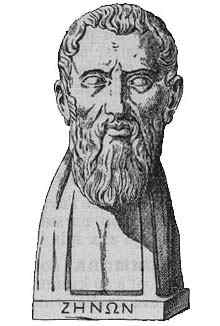
In the end, Zeno proposed several paradoxes using reductio ad absurdum, or deriving impossible conclusions from opponent opinions. However only four such paradoxes have survived. Because all things consist of motion, this was his main focus in arguments. What we may lose in exploring ancient philosophy is the level of understanding these men had, yet never where they as technologically inclined as we are today. Motion is the basis of almost all matter, and Zeno understood this. By his postulate, Zeno shows the conundrum of trying to understand the nature of life; there is more at work than simple mathematics.
Secondly, is the belief that The Creator, in being all powerful, is therefore perfect; and by being perfect allows for perfection in His’/Hers creations. In the book of John in the Gospels of Christianity, Jesus states, “...Be ye therefore perfect, as your Father in heaven is therefore perfect.” This statement not only alludes to spiritual perfection, but physical perfection. In the beginning, in Genesis, Adam is made in the image of God. Yet alone Adam would not be anything more than a body in timeless space. Before Adam the world was created, and it was perfect. What this example shows is that for a being to have a 'perfect' existence not only must the being be 'perfect' but the environment as well.
In meditative religions perfection is accomplished through prayer, fasting, and meditation ultimately leading to a state of nirvana, total enlightenment. This leads me to question, “how can a man, being erroneous in the sense that perfection is complete efficiency and total understanding, make himself perfect.” It obviously takes more than what the man contemplating the question contains. The human is a considered a system, energy and materials enter in, are processed, and then are arranged into an ordered structure. From there they are used, producing waste and the inefficient process of energy loss.
This is what is meant by evolution, nature’s best attempt at creating balance and stability. All things therefore evolve. Evolution of a species may take centuries, but technology, science, and understanding are ever evolving; this applies to knowledge as well. When an experience effects a being's thoughts, the being is thereby changed. Of course, this is not considered a physical change but a metaphysical one; one in which the thought process changes to incorporate the new information. The same process is seen in the case of physical evolution as Charles Darwin already explained. The primary focus of developmental evolution being that the change becomes a permanent in the biological structure of the organism. The change in the biological structure thereby affecting the offspring by hereditary transportation.
The third base belief is the purpose of life itself. In evaluating the belief structures of several religions, Wysong [see Philosophies on God Entry 08/20/09] presents that creationist are given structure in their lives based on the necessary need to rely on The Creator. The reason for this being that the creationist's life and development is under the direction of The Creator and therefore The Creator is responsible for the supplying of life. The creationist is likewise responsible for giving respect and joy to The Creator.
For every person, there is or are some driving factor(s) that make us want to be more than we were the day before. Granted of course, that there are those who could careless about growth and understanding, for the majority of human beings, life is geared toward experiencing more, knowing more, and understanding more. This is therefore the beginning of any civilization’s growth into controlling its evolutionary development. Without some central understanding of the matter that makes up existence, any civilization is bound for chaos. In the overall view of existence it does not matter where we came from, no one can retrace the steps, what matters now is what we do with the existence we now have and know.
