Tuesday, March 9, 2010

Not all Spheres are created Equal

In the book The Next Hundred Years by Jonathan Weiner, the adverse effects of humanity interact - negatively - with the balance of Earth's natural order. Earth is a system of a few basic-working parts. According to the book's environmentalist and naturalist author, there are seven spheres of an inhabited planet, and they can be thought of (not only figuratively but also, to a surprising extent, literally) as seven spheres.

Earth: This is the round mass of minerals and metals, spinning, more or less solid mass that forms the majority of this "third rock from the sun," and it's surface. This is considered the lithosphere: lithos for stone, and sphere because these layers are a great shell enclosing the core.

Water: With a prospective of an astronaut, the planet's supply of water also forms a great round shell, or sphere, enclosing much of the lithosphere - sometimes called the hydrosphere. All the free flowing water of the world fills this sphere, and as has been proven with the discovery of the great underwater current, has its own cycle and flow; truly representing the blood of the Earth.

Air: The third is a hollow sphere. This is known as the atmosphere. Atmosphere spewed from the volcanoes as hot gases after the crust formed and the compounds which assist in the growth of life. Ever since that time, the planet has been wrapped in a thin loose shell of gases - though the mix of gases has changed greatly over time by the natural development of oxygen producing bacteria and carbon-dioxide providers.

Fire: All planets are bathed in the light of the star(s) they orbit. Our sun formed in space more than 4.5 billion years ago, and our planet is one of nine that coalesced on the sun's periphery. The sun is a great sphere of fire and it heats Earth's atmosphere and the hydrosphere, stirring up powerful currents in both. These currents bent and twisted by the spinning of the lithosphere into all the whorls of weather. This exterior energy is providing the abundant power to fuel the development and processes that created the cycles that fuel all life. All energy utilized in the systems of being can be traced to the energy provided by the local sun of a system, just as our Sun is a constant contributor to our ecological system.

Life: With ourselves being within "the box" (in this case point, "the sphere"), it takes an open mind to perceive that in shape, the whole of life is much like the lithosphere, hydrosphere, and atmosphere: one of the concentric shells that are wrapped around the bull's-eye of the planet's core. Its existence surrounds the primary heart of the planet. The Swiss geologist Eduard Suess first called the sphere of life the “biosphere.” It could not survive without the others and is therefore, necessarily, younger than the other spheres. The biosphere is more than 3.5 billion years old according to 'scientific methods' of dating.

Ice: The planet at present has two big caps of ice, one at each pole. Some of the taller mountains are ice-capped, too. This ice forms yet another thin concentric shell, the cryosphere (cryo from the Greek for cold or frost). Of course, most of the globe is too warm for ice; but all of the scattered patches of ice on Earth do lie in the shape of a sphere. Though it might be considered a part of the hydrosphere, the cryosphere's behavior is so distinctive and influential it warrants its own position.

For all intended purposes, these spheres alone could contain the evidence of life, one celled amoebae, bacteria, and small organisms. However, what we consider to be true life and life by definition is in the presence of knowledge.

Mind: By far the youngest entrant on the list. Its point of origin is a small tribe of foragers in the African Savannah, a species called Homo habilis, which arose roughly 2 million years ago. This was a transitional species, as the evolutionary biologists E.O. Wilson and Charles J. Lumsden note:
"We can describe Homo habilis, without serious distortion, as the head of an intelligent ape riding on the body of a man."
The brain of Homo habilis (Latin for "Handyman") was significantly larger than that of other primates, and as the species evolved the brain grew at a steady rate, until our kind - Homo sapien sapiens, Man the Doubly Wise - appeared about 50,000 years ago. We are unremarkable because we can communicate mind to mind, to share knowledge from individual to individual and across generations. This sphere of power, which can affect all others, is known as the "noosphere," the sphere of the mind; but is only figurative.

It is this last sphere that has come to dominate the others. This relates to the story of Adam and Eve very easily in the fact that they are expelled from the garden for disobeying what was meant for their good. We where once in a type of homeostasis with the planet, but do to our desire we are no longer a part of the natural evolution of nature. As the planet grows and adapts to its travel and ecological progression through time, we progress as well adapting to our perceived level of comfort. Where a simple clay roof and hay floor would have done in the past, no longer is suitable for the whole of humanity. Where natural selection and evolution takes years even centuries, human technologies evolve in increments of months, even days.

Wednesday, February 10, 2010

Ever wonder the why, where and how of the existance of science? I do all the time! http://ping.fm/6KYLC

Blinded by Science - The Nature of Technology

In my earlier post - Decision Time, we began using the fictitious plant Terranus as our guinea pig for discussing social conditions for the conscience aspects of mechanical evolution. Here is the summary:

"Terranus has come to the point where I believe we find ourselves [humanity] currently. They can either continue on their current course; i.e. disintegration of their ecosystem, wars, pestilence, and divisions; or find a way to live peaceably. Let say - by some truly miraculous understanding - the Terranians come to realize the error in being divided and decide to unite. "

Terranus begins to realize the benefits of global unity, better schools, increased productivity, and more technological advancements in shorter periods of time. This is a segment of mental evolution. Mental evolution is in close relationship with Theistic evolution, in that both exist outside the physical world, but nevertheless affect it. Whether you believe in The Creator, it took something with order to take chaos and give it structure. Based upon that same principle, man has structured the world to suit his thoughts. Taking nature, with its minerals and creatures, man has given it a structure of machines with moving parts controlled through circuitry. Technology, as define in the 2002 World Book published by World Book Inc., refers to the inventions - including tools, techniques, and processes - that design to make it easier for people to satisfy their needs and desires. To get to a level of technological aptitude for biomechanical evolution to be possible, this step in technology is necessary for a civilization to accomplish.

So begins the evolution of tools and technology. Technology by nature is something man made, and as we evolved mentally, technology evolved with us. Examples of this are ever present around us, from stone scratching and engravings on walls and pillars in Rome, to the modern computers we all have come proficient in (unless you live in the stone ages, as they say.) We have lost sight of the fact that we are evolving every moment. Knowledge and wisdom are considered the seventh sphere in the spheres of nature other wise known as the noosphere. Just as with the atmosphere, the hydrosphere, and the others the noosphere changes and evolves as the systems within it change.

Technological evolution is therefore tied to the evolution of the species connected to it. In animals these are the traits that give there owners distinctive colors, poisons, or weapons that assist in guaranteeing there existence in the generation to come; the basis of natural selection. Our rapidly deteriorating ecosystem and exponential consumption of resources now force our evolution. With the pollutants we have developed, it is by technology that they have come about. Only higher technology can eradicate these hazards.

These hazards being things like chloroflouro carbons, halo carbons, hazardous waste, and ecological encroachment which all help in destroying the ozone and atmosphere; one of the most vital spheres in our ecology. A small abnormal adjustment in this area can cause the entire pyramid that man sits upon, to fall. In man, our technology is our guarantee of survival, seeing as we have stepped outside the realm of natural selection, becoming dominators of the environment, adversely affecting all seven spheres of nature.

Wednesday, January 20, 2010

Decision Time

In the book, Broca's Brain by Carl Sagan he gives his view of the times. In the years between the seventies and the new millennium most who agreed with Carl Sagan then agree today.
Pg. 47 "We are at a crossroads in human history (we've been there since the atomic bomb). Never before has there been a moment so simultaneously perilous and promising. We are the first species to have taken our evolution into our own hands. For the first time we possess the means for intentional or inadvertent self-destruction. We also have, I believe, the means for passing through this stage of technological adolescence into a long-lived, rich and fulfilling maturity for all the members of our species. But there is not much time to determine to which fork of the road we are committing our children and our future."
At one point I said we have been led down the wrong paths before - hindering us from being further advances then the ones we currently have. Sooner or later we will knock and open a door, committing to a future and a destiny we would have rather left to children's fantasies. Without taking our lives into our hands with intelligence, patience, and knowledgeable understanding we will set ourselves on a course for chaos and ultimate destruction. The reason for this conclusion is the evidences of the several societies, civilizations, and species that have all gone by the wayside into our history books. Some even becoming folklore because of the lack of evidence.

Here we will begin our observation of a civilization, with the understanding that all matter is composed of some unseen-indefinable matter that begins life with an invisible force. This invisible force makes up quarks, quarks make up neutrons, protons, and electrons, and from there we have all elements of the universe. At a peculiar point in time, this world -- we'll call their planet Terranus-- comes to the point where I believe we find ourselves currently.

They can either continue on their current course; i.e. disintegration of their ecosystem, wars, pestilence, and divisions; or find a way to live peaceably. Let say - by some truly miraculous understanding - the Terranians come to realize the error in being divided and decide to unite.
Putting aside their sociological differences in an attempt to focus, as a whole, on one goal: to no longer devour their environment, but to be completely independent from it. This is the beginning a society's biomechanical evolution.

Tuesday, December 1, 2009

Thermal Efficiency Explained

Of any system such as a machine is defined to be the ratio of the work done to the heat input:

Thermal efficiency = W/QH = Qh - Qc/Qh

All this talk of evolution and God is great for uncovering the motive behind why we do a lot of the small 'human' things we do. But all things have a law to govern them and to govern the outcome of their existence. In the human world there is no difference. This is where we expand upon the laws of thermodynamics in regards to the human system and what all this has to do with our biomechanical evolution.

Thermodynamic law applies to the properties of heat or energy in a system and in the system of life, energy is always being transferred, utilized, and transformed. Because the whole of energy is based on the power of light energy -- with its heat, matter, and wave particle properties -- we find that we are the inefficient end users in the long process of energy procession. The reason that thermodynamic law is vital to biomechanical integration is based on the key notion that any society on the brink of self-destruction must realize that efficiency is vital to prolonging the existence of their species.

Without a clean, renewable source of 'life' energy, all creatures in an ecosystem will exhaust or degenerate a vital link in the cycle, in the end. That is if the source that powers the entire system does not exhaust itself, in our case that would be the sun, and we have plenty of time to enjoy its rays.

In the laws of thermodynamics we find two vital understandings we must incorporate to create processes efficient enough for prolonged use. As well as the reason why the current situation - state of the world as some say - is so critical.

The first law states that in any system energy can neither be created nor destroyed. It is for this reason we can know that throughout the universe all matter and atomic structure is similar to the structure we find in the Milky Way galaxy. This is also supported by the second part of the first law in the fact that all energy in the system -- in this case, the universe as a whole -- is constant never increasing or decreasing. From the death of one star, comes the birth of others. From the death of one life comes another. These laws are not only mathematical but physical, mental, and metaphysical.

The second law states how energy is processed. In a system, energy will follow the path of natural occurrence (ex. hot air flowing into cold), least resistance (ex. electric conductors), and conversion of energy (gasoline engine). What this law defines is the apparent decrease in usable fuel in a system and the efficiency of a given system.

This is where some would argue evolution is flawed in that it does not follow this second law. "Look at a wooden table, it does not evolve into a tree!" I recall a misguided colleague of mine saying when I brought up the topic of evolution. What must be understood is the difference in the laws that govern energy and the laws that govern reality. In reality the table will never evolve into a tree.

But in the second law we can see how the eventual deterioration or conversion of the table could make it into something to be perceived as better. But to stay scientific, we want to look at things in matters of efficiency. As a tree, the wood use to make the table was efficient in converting CO2 into O2, now it is efficient in supporting a surface weight of 425 pounds against the pull of gravity, so which is more efficient? It is up to your definition of efficiency given a set realistic condition.

Tuesday, November 10, 2009

Changing Times at Human High

In a recent discussion, it was stated that human beings that see the human race as inadequate are trans-humanist. Trans-humanists believe that human beings need to be altered or changed to reach their full potential, and without such changes we are incomplete. Would I consider myself one such person? Not at all, I see the human race as being complete in our evolution and development. Do I want a synthetic organ so I can live longer, even forever? Or to decide the outcome of my offspring; everything from their eye color to their demeanor?

No, to that as well ... sort of. We all look to control or alter those aspects of existence with in our sphere of control. However, by doing [altering off spring or synthetic implants] so we take away the very essence of being human, our unpredictability, our vulnerability, or uniqueness. But I do consider myself a realist and I look around seeing what is going on in the world we live. We have pills to correct recital dysfunction and nothing for cancer. We invest ourselves in endeavors to the ends of space or the deepest parts of the oceans, but we do not know ourselves or take care of the people around us. Should we find what we are looking for in the galaxy around us, or uncover some new creatures in the sea would we know how best to approach them? Or what we may contract from our contact with them?

We knock on many a door, never questioning what lies behind. This has led us so far down the wrong courses in the past that we have been hindering ourselves since the beginning of time. What is the desire of a biomechanical scientist is not to make a human - cheetah hybrid so we can win more awards at the Olympics, it is so that we can better understand ourselves. In better understanding ourselves, we can then better understand all the aspects of the universe around us. It is truly the key to our survival and our understanding of matter.

Think about it this way: by reaching a higher level of understanding of everything human --i.e. the genome, DNA, brain activity, viral detection and prevention, etc.-- humans will be preparing themselves for any and all things. Not only that but without these concerns we can eliminate a lot of the wasteful by-products and pollutants that cause new conditions in the first place.

We find ourselves endeavoring to create things we need on the outside, when we truly must affect the processes on the inside for the effects to truly be positive and complete. The problems are not outside the being, they're inside.

So, what is the drive behind the biomechanical scientist? To allow for life as we know it on a higher level of homeostasis with the planet and universe in which we live. Not to create new human life forms but to ensure that we continue to exist and continue to gather information that can make the life we know, more productive. By integrating the outcome of biological, mechanical, technological, and sociological enterprises into the structure of our species, we can accomplish the things we do daily with all manner of devices, pills, creams, treatments, and technologies.

Sunday, September 6, 2009

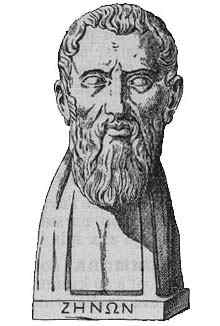
A Philosophy of Zeno

(Continuing from Philosophies on God)... For example, the great Greek philosopher Zeno of Elea (490?-430?) proposed this mathematical truth:
A runner could never [mathematically] cross a course and complete a race. This is due to the fact that a person must first cover half the distance to the purposed point of contact. After which, the person must then cover half of the remaining distance. At no point does the resulting mathematics truthfully reach zero allowing for the completion of the task.

Zeno of Elea studied under Parmenides (515?-450?). Parmenides was the most important early Greek philosopher to live before Socrates.
He taught that the origin and nature of reality must be taken from logical arguments. What is not is a notion not able to properly thought of or spoken of. Parmenides taught Zeno that the world, when not defined by what is not but what is, is just one thing -- unchanging, perfect without a beginning or end.

In the end, Zeno proposed several paradoxes using reductio ad absurdum, or deriving impossible conclusions from opponent opinions. However only four such paradoxes have survived. Because all things consist of motion, this was his main focus in arguments. What we may lose in exploring ancient philosophy is the level of understanding these men had, yet never where they as technologically inclined as we are today. Motion is the basis of almost all matter, and Zeno understood this. By his postulate, Zeno shows the conundrum of trying to understand the nature of life; there is more at work than simple mathematics.

Secondly, is the belief that The Creator, in being all powerful, is therefore perfect; and by being perfect allows for perfection in His’/Hers creations. In the book of John in the Gospels of Christianity, Jesus states, “...Be ye therefore perfect, as your Father in heaven is therefore perfect.” This statement not only alludes to spiritual perfection, but physical perfection. In the beginning, in Genesis, Adam is made in the image of God. Yet alone Adam would not be anything more than a body in timeless space. Before Adam the world was created, and it was perfect. What this example shows is that for a being to have a 'perfect' existence not only must the being be 'perfect' but the environment as well.

In meditative religions perfection is accomplished through prayer, fasting, and meditation ultimately leading to a state of nirvana, total enlightenment. This leads me to question, “how can a man, being erroneous in the sense that perfection is complete efficiency and total understanding, make himself perfect.” It obviously takes more than what the man contemplating the question contains. The human is a considered a system, energy and materials enter in, are processed, and then are arranged into an ordered structure. From there they are used, producing waste and the inefficient process of energy loss.

This is what is meant by evolution, nature’s best attempt at creating balance and stability. All things therefore evolve. Evolution of a species may take centuries, but technology, science, and understanding are ever evolving; this applies to knowledge as well. When an experience effects a being's thoughts, the being is thereby changed. Of course, this is not considered a physical change but a metaphysical one; one in which the thought process changes to incorporate the new information. The same process is seen in the case of physical evolution as Charles Darwin already explained. The primary focus of developmental evolution being that the change becomes a permanent in the biological structure of the organism. The change in the biological structure thereby affecting the offspring by hereditary transportation.

The third base belief is the purpose of life itself. In evaluating the belief structures of several religions, Wysong [see Philosophies on God Entry 08/20/09] presents that creationist are given structure in their lives based on the necessary need to rely on The Creator. The reason for this being that the creationist's life and development is under the direction of The Creator and therefore The Creator is responsible for the supplying of life. The creationist is likewise responsible for giving respect and joy to The Creator.

For every person, there is or are some driving factor(s) that make us want to be more than we were the day before. Granted of course, that there are those who could careless about growth and understanding, for the majority of human beings, life is geared toward experiencing more, knowing more, and understanding more. This is therefore the beginning of any civilization’s growth into controlling its evolutionary development. Without some central understanding of the matter that makes up existence, any civilization is bound for chaos. In the overall view of existence it does not matter where we came from, no one can retrace the steps, what matters now is what we do with the existence we now have and know.